
Elmira Resident Lookup Record Coverage
Each Elmira name verification has a different best starting point. A current registration question belongs with the state voter tool, while a parcel question belongs with Chemung County mapping and the assessment roll. A case-specific question belongs with the court system, and an earlier-era question may belong at the library. None of those records alone establishes a complete identity. Use the narrowest official source that answers the question, preserve its date, and seek an independent match before treating a similar name as the same person.
| Record | What It Can Confirm | Official Place | Access Boundary |
|---|---|---|---|
| Voter registration | Registration status and election jurisdiction as returned | New York voter lookup | Registration-only result; broader files have election-purpose rules |
| Assessment roll and GIS | Parcel owner field, situs, mailing field, class, and map relationship | Chemung Real Property Tax Services | Roll date matters and ownership is not identity proof |
| Court index | Party, case, court, and entered events where displayed | New York eCourts | Sealing, entry, retention, and case-type limits apply |
| Vital record | An event fact under the custodian's eligibility rules | Chemung Vital Records | Not open for unrestricted inspection |
| License or entity file | Public status, type, and listed location fields | New York license search | Separate systems and displayed-field limits apply |
| Historical directory | Earlier address, category, or locality context | Steele Memorial Library | Gaps and common names require a second source |
For a current Elmira resident question, first record the spelling used and the county or municipality. For an earlier Elmira question, begin with a dated directory, newspaper, or census lead and then test continuity in another year. A parcel can connect a name to a location, but its situs and owner mailing fields must remain separate. That distinction prevents a mailing address from being mistaken for a physical location.
Elmira Voter Record Fields
The state voter lookup is a narrow current-registration check, not an Elmira resident list. Its form uses County, Last Name, First Name, date of birth in month/day/year form, and ZIP Code. Use the county that matches the registration and only test a prior surname when it is lawful and relevant to the record question. A no-result can reflect a spelling, county, ZIP, date, or registration-status mismatch. It does not answer every question about an Elmira resident.
The New York voter lookup shows the official search form used for this limited check.
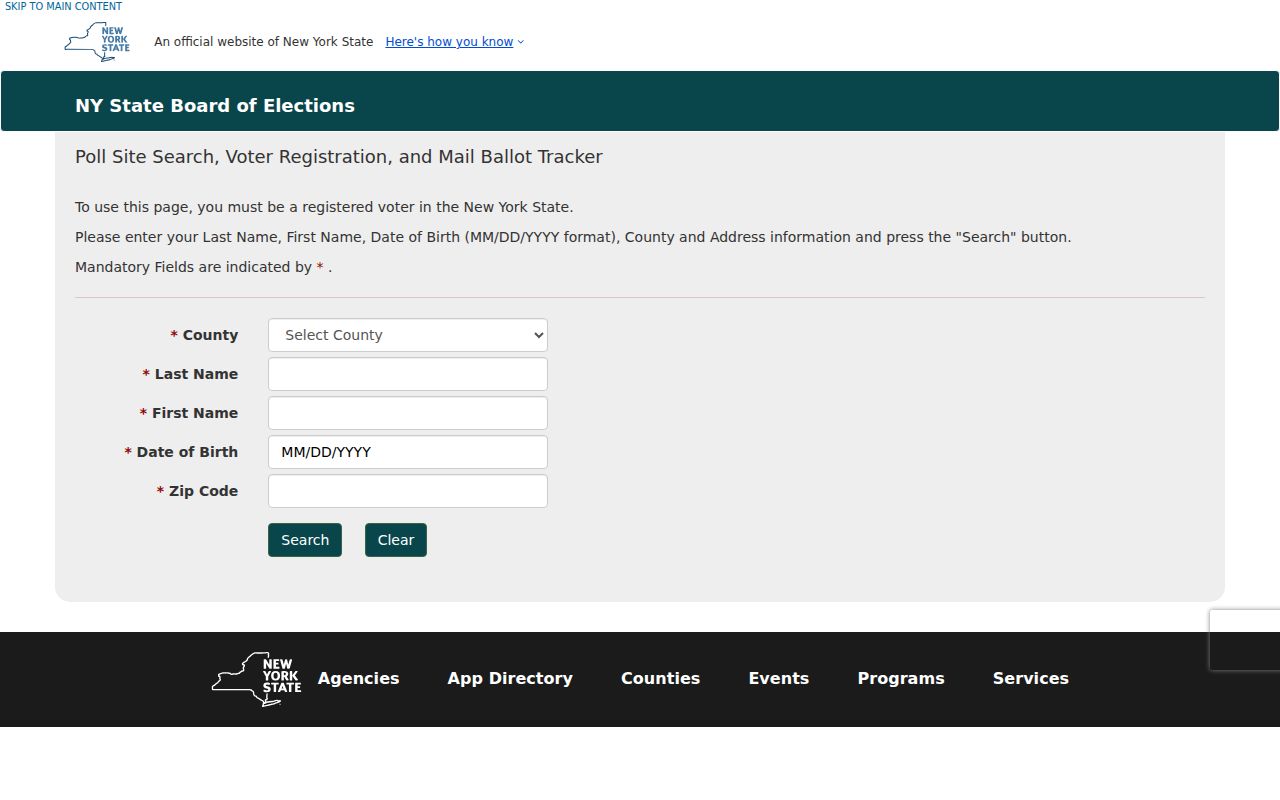
Record the date of the result and treat it as a registration-status point in time. New York makes registration records public within statutory boundaries, while a request for a full voter file must state an election purpose. Use a permitted lookup to corroborate a known name, not to assemble an Elmira block roster.
Note: A current voter result and a parcel record may carry different dates, so retain both dates rather than forcing them into one conclusion.
Elmira Court Record Paths
New York eCourts routes a name search by court level and case type. NYSCEF Case Search provides Case Identifier, Name, Tax Cert/SCAR, and New Cases modes. A Name search accepts a business or organization name, or first and last name, with a middle name optional. County, case type, and date range are useful narrowing controls. Save the selected county and court with any result, because a matching name without its jurisdiction is weak evidence.
The NYSCEF case-search guide documents those modes and narrowing choices.
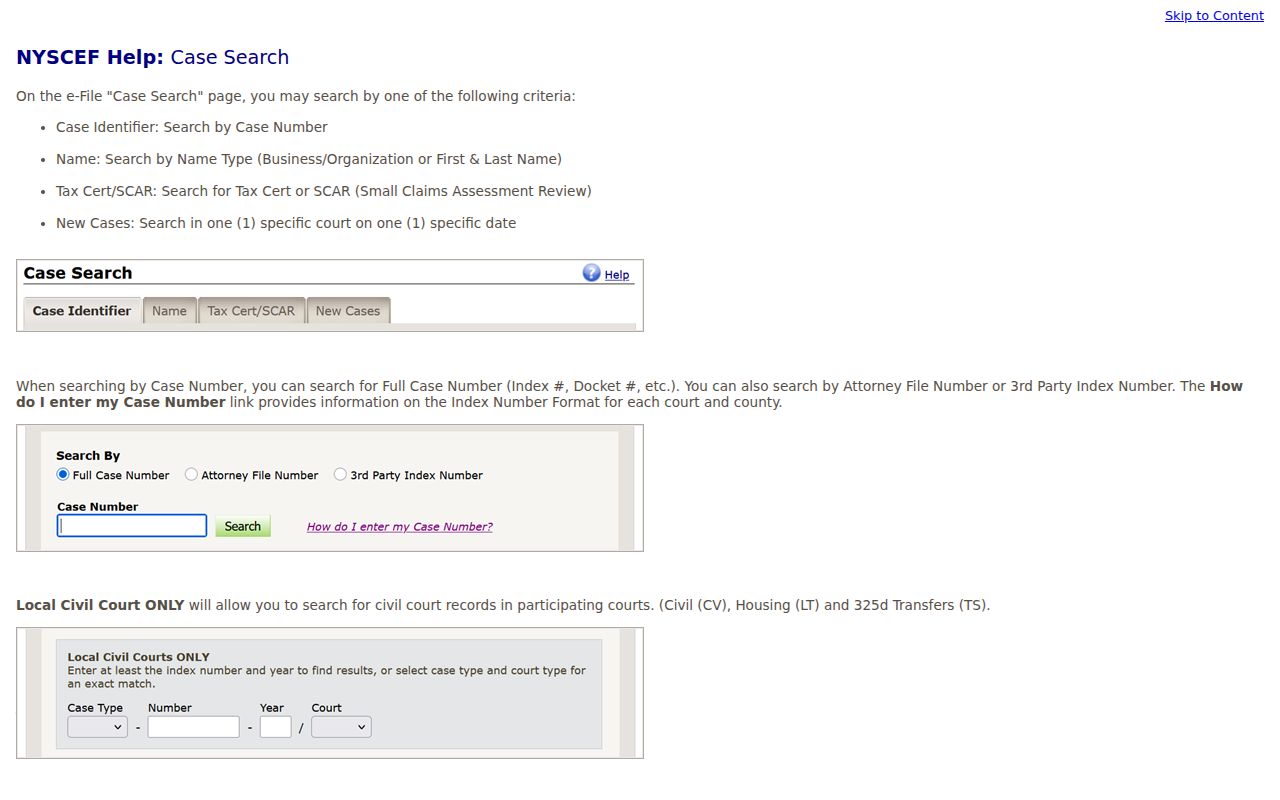
When a result is available, its useful inventory can include a case or index number, party names and roles, county and court, case type, filing or commencement date, event dates, status, and e-filed document links where available. The research did not expose a live Chemung docket sample, so exact current result labels should be checked in the system itself.
An empty court search has several possible causes. Sealed cases, adoptions, certain mental-hygiene or youthful-offender matters, and matters not yet entered may not appear. For a paper file, the clerk or county clerk needs the exact court, index number, party, date range, and document sought. A name by itself creates ambiguity.
Verify an Elmira Resident Lookup
A careful Elmira record check starts with a match field and then seeks a second one. The independent field may be an exact address, middle initial, public organization, parcel, case number, or year. Keep the searched form of the name, variants, source URL, record date, match field, possible non-match, and next step together. If two sources disagree, preserve both dates and identify the custodian rather than choosing the newest record without context.
- Use a permitted voter result or the assessment roll to anchor the name to an Elmira address or parcel, while keeping situs and mailing fields apart.
- Search the name and a documented variant in the correct court route, then save the county, court, case type, and date range used.
- Compare only the event details available through the vital-record custodian or historical index, including the date and locality needed to distinguish a similar name.
- Ask the custodian for a certified or genealogy record only when the applicable eligibility rule and the defined record purpose are met.
- Docket
- A court's running record of a case, including filed or entered events that the court makes available.
- Index and image
- An index is a searchable listing or reference. An image is the scanned document, which may have different access or fee rules.
- Certified copy
- A copy issued by the authorized custodian with its certification, available only when that office's rules allow it.
For an earlier name-and-address trail, compare two directory years at Elmira's city directory collections before assuming continuity. A repeated address is useful evidence, but a common name still needs another dated match.
Elmira Vital Record Access
Vital records are a verification route with firm access limits. Chemung County Vital Records holds local births and deaths, with no county records before 1875. The county accepts eligible certified and genealogy orders in person, by mail, email, or fax under its application rules. A request should supply the full record name, exact or approximate event date, parent information when known, useful name variants, requester contact details, and lineage or death proof when required. Every inquiry fee can produce a record, transcript, or no-record response, and the fee is not refundable.
For genealogy requests, Chemung lists a birth threshold of more than 75 years with the person known deceased and a death threshold of more than 50 years. Direct descendants may have a route around an age rule with proof. The posted routine processing range is 5-10 business days plus mailing, with no same-day or expedited service. State Department of Health records generally cover outside-New-York-City birth and death registration from 1881, with separate certified-copy and genealogy eligibility rules.
Marriage records follow a different Elmira path. When the original license was issued by the municipal clerk, the request goes to that municipal custodian rather than County Vital Records. Keeping the event type, issuing office, and eligibility rule together avoids a request sent to the wrong place.
Elmira No-Result Record Route
No result is a useful research note, not a conclusion about a person. Check the county, name variation, date, source coverage, and access boundary. A court entry may be sealed or not yet entered, a vital request may fail an age threshold, a directory year may be missing, a parcel may have been renumbered, or a portal may be unavailable. When the reason is not known, label the outcome as not located in official sources and keep the exact search path.
For an existing county record that is not online, the Chemung County public-records route accepts a written request by mail, email, or fax, and offers a records-review appointment by phone. State FOIL concerns identifiable existing agency records. It does not require an agency to create a new personal profile or answer an open-ended research question.
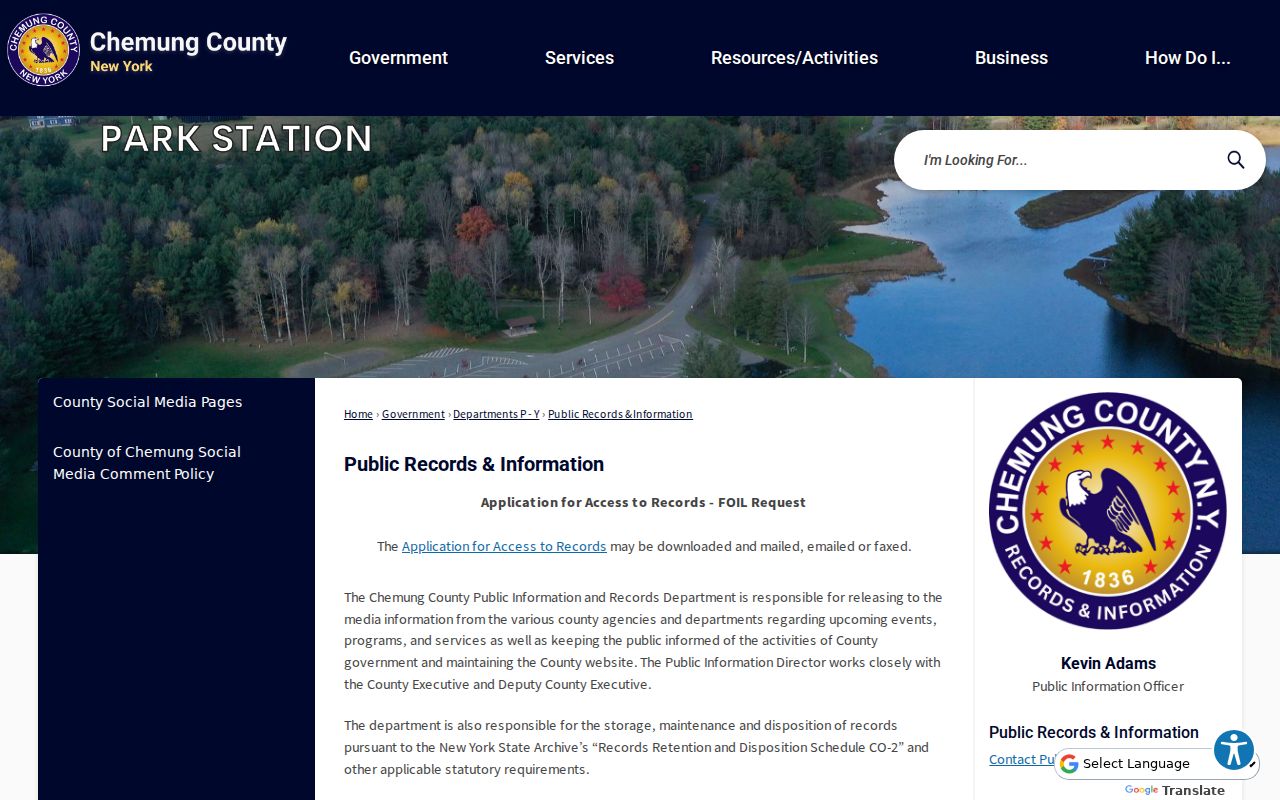
A focused request identifies the existing record, department or custodian, date range, and delivery preference. County guidance also distinguishes vital records, municipal marriage records, and divorce records from the general FOIL path, so a request should be sent to the correct office from the beginning.
Elmira License Record Checks
New York's public license and entity systems can help test a public role without proving where an individual lives. The Licensee Name Search uses Last Name, First Name, License Type, County, City, and ZIP Code fields, with full or partial names and an all-license-types option. Its displayed status or location is a source-specific data point, not proof of a current Elmira residence. Some license categories use separate systems, so a no-result may mean the wrong database was used.
The Department of State business-entity database is likewise a status resource. It can display entity name, organization date, jurisdiction, county, service-of-process address, registered agent, and status. Compare an entity address with the person question only when a dated record makes that comparison relevant. Do not turn a business filing into a residence claim.
Elmira Privacy Record Limits
Public availability does not authorize a private profile. New York FOIL covers access to existing agency records and includes special limits for lists of names and residences. Driver and motor-vehicle information has separate legal protections, and an Address Confidentiality Program participant may use a substitute mailing address. That substitute address is not evidence of where the participant lives and should never be reverse-traced. A person seeking correction of their own state-agency information has a separate privacy procedure.
Lawful use. This Elmira record-check route is for personal, lawful research and verification. Do not use a record to stalk, harass, intimidate, or harm anyone; New York Penal Law §240.26 is a reference point for harassment concerns.
Use the original custodian, preserve official redactions, and minimize the details copied into working notes. The correct response to a sensitive or uncertain result is to return to the responsible office, not to fill gaps by inference.