
Elmira City Directory Holdings
Elmira's historical directory trail is split among a local reference collection, state microforms, a digitized scan, and archival companions. The Steele Memorial Library local-history collection describes directory holdings for 1860, 1868, 1876-77, and 1886-1975, while also cautioning that early years are incomplete. The New York State Library inventory is the precise check for its own Elmira fiche and film holdings. A researcher should record the collection, year, and access route before treating a missing volume as a missing household.
| Collection | Years | Where Held | Access |
|---|---|---|---|
| Elmira historic directory microfiche | 1857/1860 | New York State Library | On-site, noncirculating microforms |
| Elmira historic directory microfilm | 1861-64; 1871-72; 1875-76; 1884-85; 1888; 1890; 1893-95 | New York State Library; Steele | On-site reference use |
| Elmira historic directory microfilm | 1897-1912; 1914-42; 1944; 1946; 1949 | New York State Library; Steele | On-site reference use |
| Elmira 1911 digitized directory | 1911 | NYHeritage | Online scan |
Steele's broader local description does not prove an unbroken yearly run. The state inventory names the exact years it holds, including a Chemung County directory for 1885. When a year falls between listed volumes, use a nearby directory and a dated newspaper, census, or yearbook rather than silently filling the gap. The printed directory remains a historical lead, not a present-day address source.
Elmira Directory Years on Film
The numbered runs offer a useful research ladder. Fiche covers the earliest pair in the state inventory, and the film sequence resumes in discrete groups rather than as one continuous shelf. That pattern matters when a surname disappears. A gap can reflect collection coverage, publication timing, or the limits of the surviving material. It does not by itself show that a person left Elmira.
- 1857/1860: the State Library lists these Elmira directories on fiche.
- 1861-95: film holdings appear in several documented clusters, with named gaps between them.
- 1897-42: the inventory supplies a long film sequence before later individual volumes.
- 1944, 1946, and 1949: these are the later exact years in that State Library inventory.
For a local run beyond the state list, ask Steele staff which volume is available and whether it is a directory, a phone book, or another reference item. Reference holdings are open to the public but many do not circulate. Note: Write down the year printed on both the title page and the scan or reel label before comparing two entries.
Elmira's 1911 Directory Volume
The 1911 Roberts Brothers volume is a particularly broad Elmira historical-directory source. Its catalog description identifies 720 pages and coverage for Elmira, Elmira Heights, and Horseheads. It contains general citizens, business and classified material, a street and house directory, churches, schools, organizations, societies, a miscellaneous register, and a map. That regional scope is important: an entry in the volume should be checked under its locality heading and street section before it is treated as a City of Elmira record.
The digitized 1911 Elmira directory record is the source for the available scan.
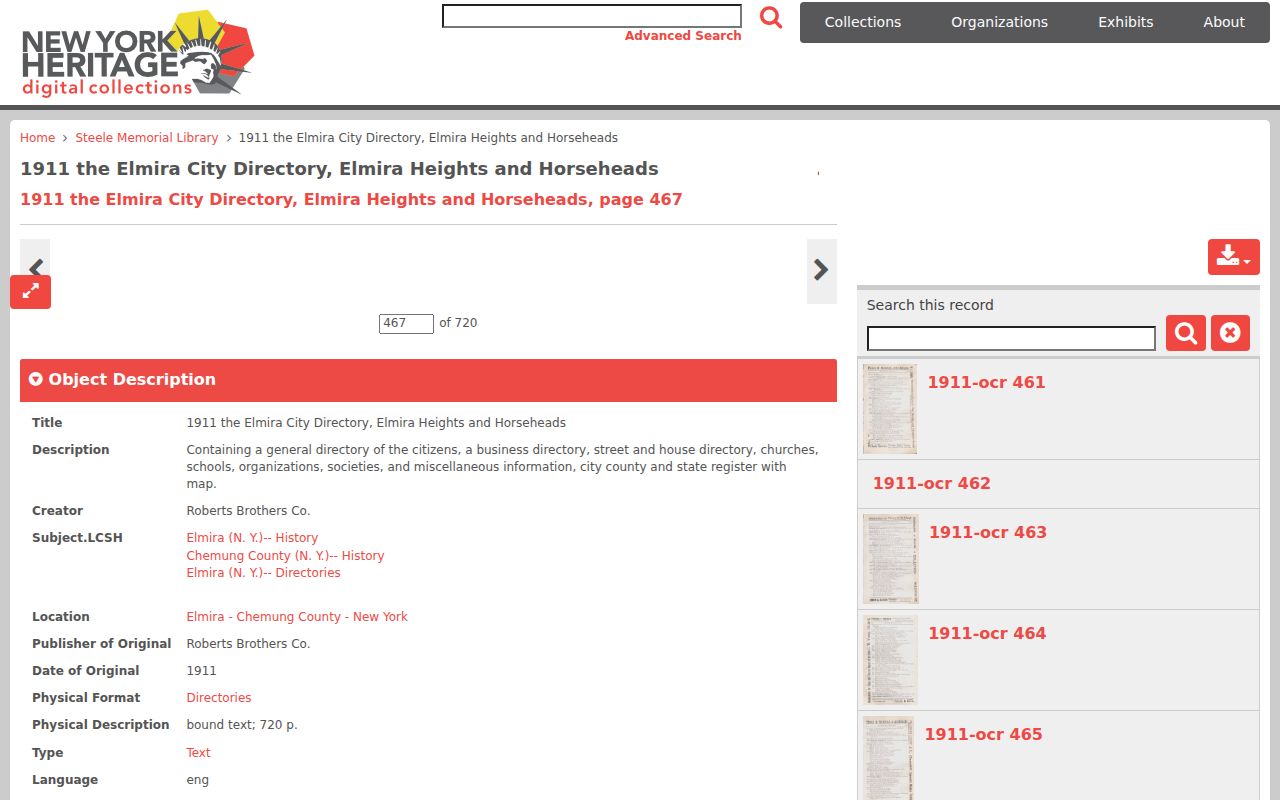
The record page is a starting point for opening the volume. Read the actual page that carries a name or address, because catalog metadata cannot resolve a common surname or a locality mismatch.
Reading Elmira City Directory Entries
A historical directory entry needs to be read as a compact index, not as a full biography. The locally documented workflow begins in the general citizen section: record the full name, occupation or category, address, and any house or residence notation. If a firm or work category appears, check the classified business pages. Then use the street or house section to see whether the address sits on the expected block. A repeated address in two years supports continuity, but it cannot prove identity when names are common.
| Title and year | Identifies the volume that supplied the entry. |
|---|---|
| General citizen entry | May supply a name, occupation or category, address, and a house or residence notation. |
| Street or house entry | Places the address in the volume's street-order material. |
| Business or institution entry | Can connect a listed firm, organization, school, church, or other local listing. |
| Front matter and map | May explain abbreviations, coverage, and street context for that edition. |
- Criss-cross directory
- A street-order directory section that reverses the usual name-first path and helps test an address against nearby listings.
- Householder index
- An index arranged around a household or address rather than only an alphabetical personal-name listing.
- Abbreviation key
- The explanatory list, often in front matter, that tells a reader how the volume uses short marks and labels.
Elmira Directory Street Sections
Hanford's 1900 transcription demonstrates why the street portion of an Elmira historical directory is more than a second index. It describes a general citizen directory, classified business directory, house directory, city map, and government, school, and society material. Its street instructions use cross streets, sides of the street, and unnumbered streets. The example for East Water 505 places it between Madison and Dewitt, with even numbers on the right.
Those instructions are a historical address-conversion method, not a current map rule. Consult the 1900 Elmira street and house-directory transcription for the documented method, then compare a dated directory or map before applying it elsewhere. A street number can change, and a historical name can require a separate cross-reference.
Elmira Archive Research Ladders
Directories become stronger when they are paired with nearby local sources. Steele lists local newspapers from 1835-present, five-area-school yearbooks from 1909 with missing years, federal census microforms, Chemung County census years for 1855, 1892, 1905, 1915, and 1925, and early Catholic records for 1848-1910. Its research guides also point to vertical files, cemetery PDFs, family genealogies, locality guides, military guides, and an Excel holdings list.
The Steele local-history collection shows the shelves and research categories that support those cross-checks.
A surname may appear in a vertical file rather than the library catalog. Use the guide before requesting a staff search, and preserve the date and source title alongside each directory finding.
Elmira Library Manuscript Leads
For material that is not a printed directory, Booth Library at the Chemung Valley History Museum holds about 3,000 books, 30,000 manuscripts, 16,000 photographs, and 11,000 maps or architectural drawings. Its strengths include family papers, government records, local transport material, Elmira Prison Camp records, Mark Twain material, and unofficial births, marriages, deaths, and burials. The research room is open Monday through Friday from 1 to 5, with distance research available.
Booth's scale can turn a directory lead into a focused archival request. It charges $5 a day for nonmembers, while students and members are free. The Booth Library holdings page supplies the current institutional route and archivist contact. Sanborn maps and local atlases offer a different check: they can show whether an address was a house, institution, or commercial building, but they do not name every resident.
A documented Elmira Sanborn map page from about 1898 gives a useful map layer. Use it to test building footprints, street geometry, and block context beside a dated directory entry. It is an address-context source, not a substitute for a name entry or a directory year.
Tracing Elmira Family Directories
Trace a household through the Elmira historical-directory record one dated volume at a time. Begin with the earliest certain entry, then copy the address and category exactly. Compare the next available year, including the street section, before concluding that a move occurred. Pair a directory sequence with the appropriate census years, a newspaper notice, a yearbook, cemetery record, or an archival item. When an old directory clue needs modern address-keyed work, the Elmira street directory has the separate current-record route.
- Find the first confirmed entry and save its title, year, page, name, category, and address.
- Check the next available directory year, not an assumed annual sequence, for a repeat, move, or variant spelling.
- Read the street or house section to test the block context and any historical numbering instructions.
- Pair the dated run with the relevant census, newspaper, yearbook, cemetery, or archival source.
- Mark an unexplained disappearance as unresolved until an independent source supports a move, death, or other change.
A directory can show continuity in a local listing. It cannot by itself establish title, legal residence, or a complete household. That restraint helps separate a useful family-history lead from an unsupported conclusion.
Elmira's Records Timeline
Elmira became a city in 1864, while Elmira Heights incorporated in 1896. Chemung County was created from western Tioga County in 1836, so an early family search may need Tioga material before a Chemung record. The city-directory series sits beside a longer record landscape: local newspapers begin in 1835, and city minutes are posted online from January 2011 forward. Dates and jurisdictions should stay visible in research notes because an Elmira label can refer to a city, village, town, county, or broader postal area.
The Elmira Agenda Center is the current civic archive route for dated council and commission material.
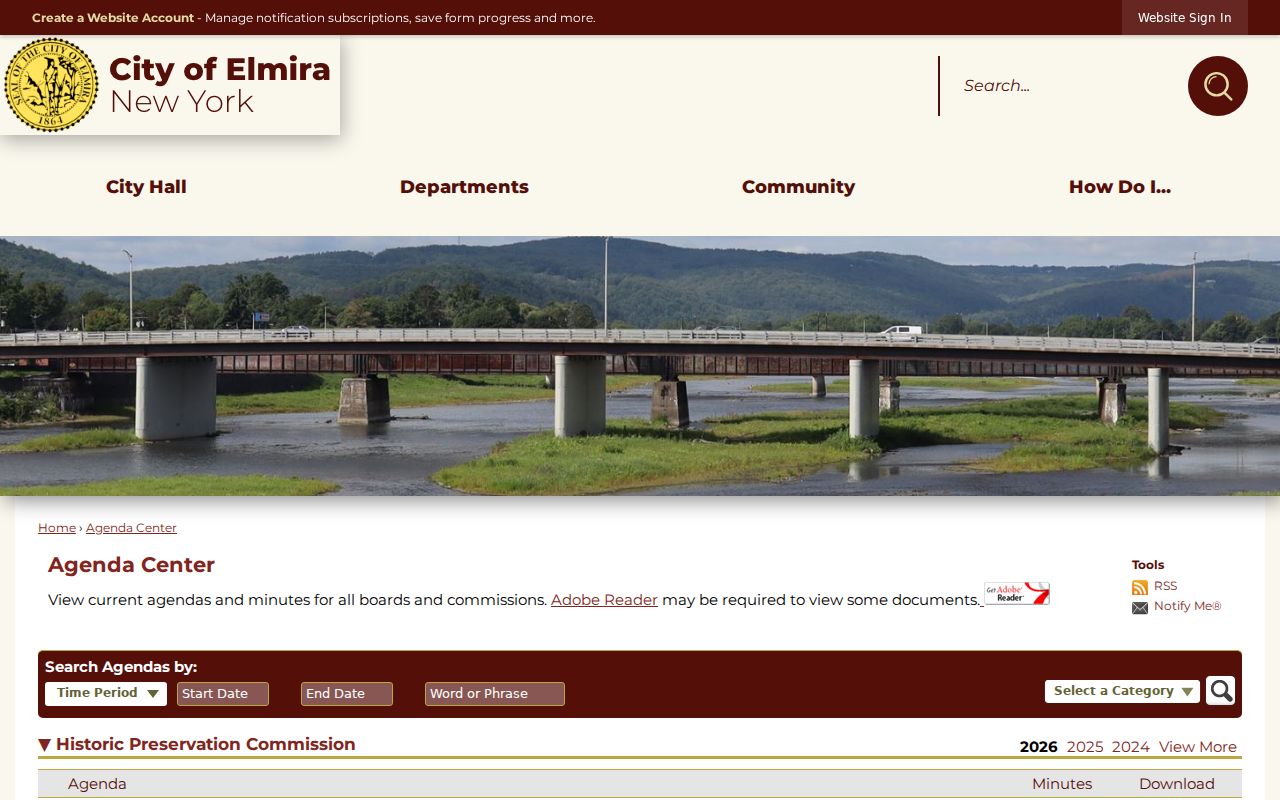
Agenda and minute records are dated institutional documents, not household directories. Search by a precise name, organization, street, or date window, then retain the document date with the result.
Elmira City Record Context
Current city records can support a historical directory finding, but they are not a current household list. The Elmira City Clerk at 317 E Church St handles FOIL routing, council minutes, permits, licenses, and certificates on weekdays from 8:30 to 4:30, at 607-737-5672 or 607-737-5673. Minutes are posted from January 2011 forward, and the Agenda Center can be narrowed by date, phrase, and category. Use the city department directory to identify the responsible custodian before sending a dated request.
The City Assessor keeps inspectable rolls, descriptions, values, and exemptions. Code Enforcement maintains permit and inspection records at 101 W 2nd St, while the Records Bureau accepts FOIL requests through its online NextRequest route or a hard-copy form by fax or email. The Records Bureau states that it will make records available, deny, or acknowledge a request within five business days. City marriage records also have a separate eligible-requester route, including a $22 genealogy search for a deceased couple's relative. Keep these current channels distinct from the historical Elmira directory shelf.
The current city archive search uses keywords, an archive selection, a time period, and start and end dates. That makes it useful for locating a dated meeting, permit-related record, or public document after a historical directory supplies a name or street. Record the archive category and document date with the result. Current staff, council, and commission pages belong to a different time layer from the historic printed volumes, so their dates should never be blended into a directory-era claim.